Specimen C20/NA/1415600.01 – American Broad Twill Ware
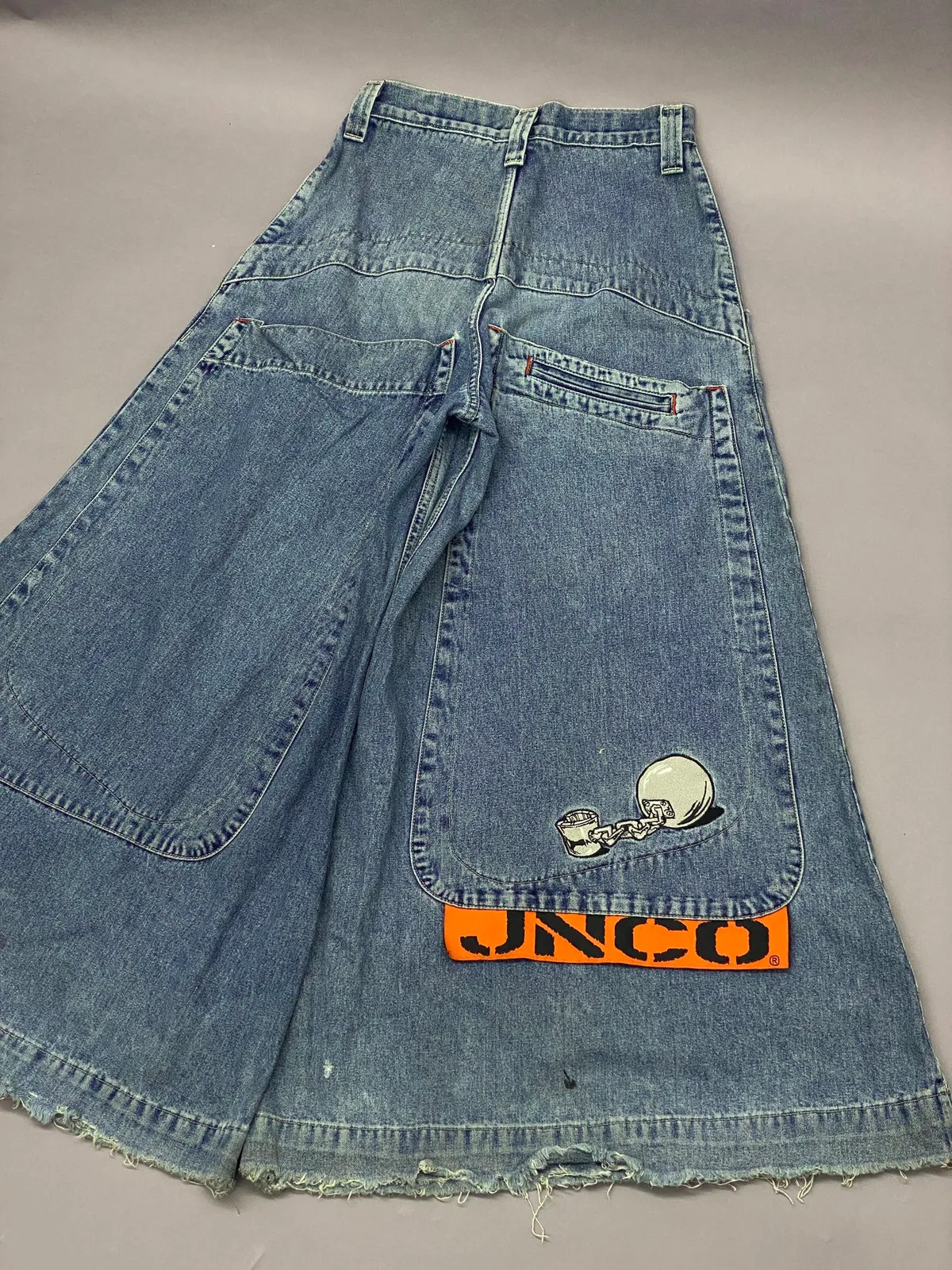
American broad twill ware, often better known in the literature by the mysterious "JNCO" inscription found on most examples, is a type of garment from late C20 North America. It is found very sporadically as a grave good, often in burial sites dated 20 to 30 years later than the approximate peak of broad twill garment production. Most commonly, it's encountered in refuse piles or occasionally in large caches of never-worn examples.
This specimen is a representative example of middle-period broad twill ware. It is a lower body garment with a characteristic and very unusual wide shape, which leaves large empty flaps of fabric out to either side of the body and between the legs.
The social function of these garments remains a mystery. They were produced in large numbers, but are a clear minority relative to other, more common uses of the blue cotton twill fabric that is ubiquitous in this era – See specimens under C20/NA/141509; C20/NA/141510; C21/NA/141511 for common early, middle, and late period variants of American Twill Ware.
One prominent theory proposes that there should be a cultural significance to the fact that these garments would easily snag on the swiveling doors of North American automobiles (Gárman 94). One hypothesis is that, as "cars" were sacred to this culture, they were used as a form of punishment, ritual humiliation, or even trial by ordeal (Gárman and Myr 95). This view is not universally accepted; it is possible, instead, that these were willingly worn by a mystery cult or religious subculture that rejected the sacred role of the automobile (Wei 97).
Some scholars discount the automobile explanation as "overfitting" and instead point to the large volume of fabric used in the manufacture of the garment itself, suggesting that it was a form of conspicuous consumption. Some sources from this period do suggest that the blue cotton twill fabric was highly prized; one 2023 shipping manifest suggests that a bolt of this cloth imported from Japan cost more than a month's worth of manual labor, though how representative this figure is remains in question.
It is known that while blue cotton twill was worn primarily in lower body garments, some high-status individuals wore matching upper body garments. While there is no direct evidence of this, the broad twill ware garment may be an extension of this, hanging even more of the prized fabric on the body in a display of wealth (Arkád 99).
The decorative embroideries and symbols found on these garments are also of unknown origin, and are thought to be devotional icons or depictions of animalistic ancestor figures. They sometimes display superficial similarity to the animal figures found on C20/NA/1416124.01 and like examples, designated American printed rabbit cotton ware. However, the lack of detail specificity has led some (Wei 97) to caution against viewing this as evidence of a shared pantheon or mythos, which is taken as evidence for the theory that these belong to a distinct, anti-automobile religious community.
This specific example is one of 1,200 specimens recovered from the Salinas "dead mall" site, most of which are now in private collections.