YOU MUST FREE YOURSELF FROM THE TYRANNY OF "MEANINGFUL CHOICES"
So as I start writing this piece, I have just finished (remotely) watching Nicholas O'Brien's talk at Narrascope, "I know narrative designers who use branching dialog and they’re all cowards". I'm not going to get into summarizing the exact contents of the talk itself, I think Nicholas can do that in his own words, but here's the summary as given on the conference schedule:
Branching narrative is widely used in indies and AAA games, but does it inherently increase player agency? I argue that if employed too casually, it can create a wedge between user and story. I propose that contemporary games overuses choice-based dialog as a crutch, off-loading storytelling onto the player. “Flavor paths” – low/no-stakes choice-based narrative – have neutered the power that choice-based mechanics can have within narrative gameplay. Games that forgo flavor paths in favor of linear story or “consequential design” will hopefully inspire narrative designers to reclaim their stories from the (cowardly) branching paradigm. (Important note: I too am a coward.)
(Emphasis mine)
I'll be completely honest: I picked this talk to watch in its time slot specifically because I already thought I was going to want to push back on this idea, and so here I am pushing back. Obviously there's more to the actual material presented than this central argument here, and Nicholas presented both a few examples of what he's talking about and some instances of what he thinks are ways forward outside this perceived overuse of branching choices.
In truth, this article isn't really a specific response to specific points in the talk so much as it's me wanting to bring some missing context to bear on the underlying rules of engagement of this discussion. The talk is now available on YouTube if you're curious.
So: I think when we talk about "flavor choices" in these terms and we place them in inherent opposition to "meaningful" or "consequential" choices we're actually building a very different type of mental scaffold than the one that would actually be useful to us. I think we need to be thinking of choices in branching narratives are a structural tool that has multiple overlapping functions.
Branching choices have a structural dimension; they take part in literally defining the shape of the narrative from the standpoint of which textual fragments are or aren't included. But they also have a rhetorical dimension; choices say things, in themselves. I tend to make an analogy to the role of editing in cinema, where edits similarly act both as a broad organizing system for a film narrative and as immediate components of its rhetorical or aesthetic content.
And importantly, choice and branching are distinct and independent things. They're often closely coupled and even conflated, of course. But examples of choice without branching are common; many false choices merge immediately, not even including a single line of acknowledgement of the player's choice. However, this doesn't mean that they are necessarily narratively empty. Consider this toy example:
The therapist idly stretches his fingers, not really looking at you.
"And when your father found out, how did he react?"

* "He was angry. Read me the riot act."
* "Didn't really react at all, at first. But he wouldn't look or talk
to me for days afterwards."
* "He said a few things about how disappointed he was, but I don't
think his heart was in it."
-

"I see." He jots something down on that notebook of his. "And how
did that make you feel?"
It's very clear, narratively, that what the player character says here matters not one iota to the therapist, and has no unique response at all. And yet, by taking one of these choices, the story has materially changed. A choice is ultimately a question you're asking the player, and sometimes the function of a question is to let the player hear their own answer. This example has a purely rhetorical function;1 Most choices in traditional branching narratives have both rhetorical and structural components.
A more functional-in-place example of a purely rhetorical choice is this classic moment from Pathologic 2:
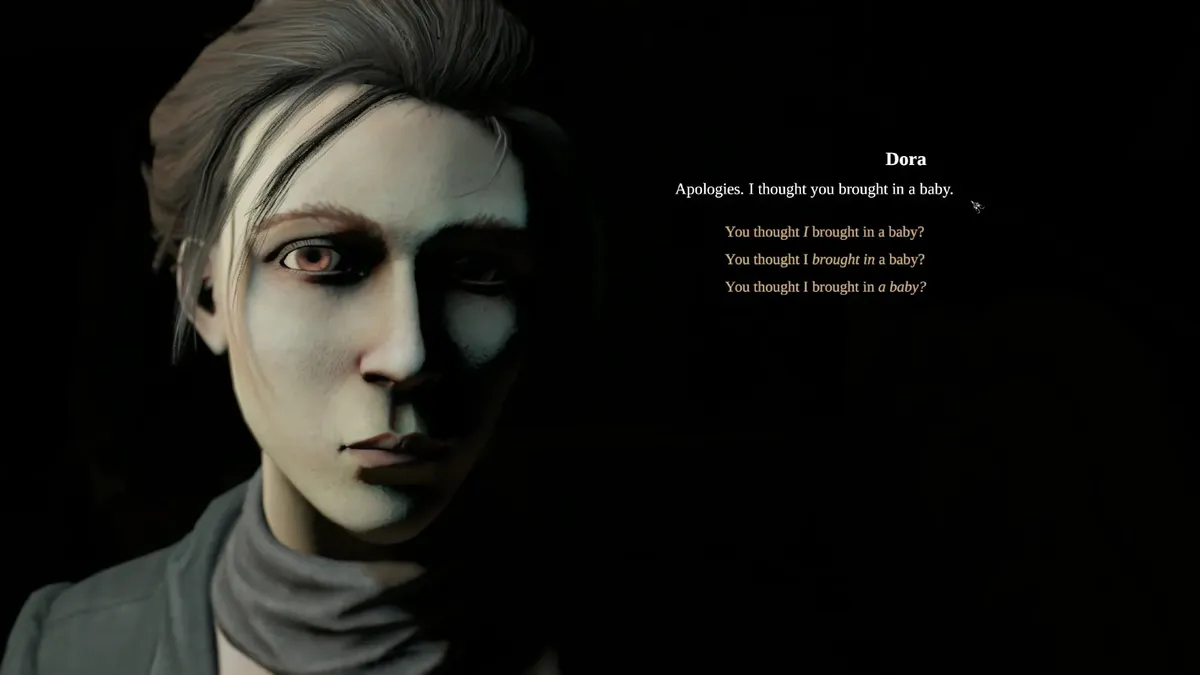
Here, the rhetorical function is that of a joke. The joke can only exist not only as a choice beat, but in a narrative that has a large number of them, where most are in fact quite inconsequential—but certainly not all. Pathologic, in general, lives in the ambiguity of how much your choices "matter". NPCs in those games will lie to you, get offended if you say the wrong thing to them, or simply not deliver information you need if you guide the conversation away from the topic. Players are, then, asked to make a judgement call about how to navigate each conversation. I really think this demand for close reading is a big driver of how much Pathologic sticks with people and why the games have such a loyal following.
For many games, dialogue choices are a core mechanic (sometimes the only core mechanic), and so they are a means to many different narrative ends. That they don't uniformly have the same level of stakes or "consequence" is, for those games, a feature and not a bug. We shouldn't treat this as a problem to be solved any more than platformer level designers should view it as a problem that there are easy jumps and hard jumps, that some jumps are over a death pit and others are only required to get an optional collectible.
When I talk about the rhetorical function of choices, then, I'm really putting a broad umbrella over a world of different lines of storytelling. Sets of choices always create an implicit boundary—why do I have an option to yell at this character, but not punch them in the face? And that boundary then takes part in communicating, to the player, about the boundaries of the milieu or the player character's freedom of action. Choices can act as an extra line of internal monologue, surfacing what the player character might be thinking without a more conventional device like interior monologue.
Choices can enable player fantasy and alignment. There's a particular moment in Star Trek: Resurgence that I think is really illustrative of this. In the Star Trek setting, characters often give commands to computers or space ships by using a "voice authorization," a sort of pseudo-password with a defined format. In Resurgence, when the player character is about to give their voice authorization code, the player is actually asked to choose what that authorization code is.
This is a complete non-choice, even from an in-universe perspective—those codes aren't chosen, they're assigned, and the character is merely recalling theirs. What the player choses here affects not at all what happens; there's no way to be wrong or misremember the code. But of course, the act of choosing creates alignment; of course you know the code, you're the damn captain, and so that you are deciding to say "alpha" instead of "delta" is significant to a degree that merely pushing a button to advance the dialogue without choosing wouldn't be.
The player in this moment has absolutely no agency, their choice is entirely and explicitly not a "real" choice. And yet it's still completely effective interactive storytelling and is a nice touch over not having a choice there at all.
Which brings me to the important point that agency, too, is just a rhetorical device. You cannot treat "more agency" as a goal in itself, especially because "agency" is more a family of distinct things and not one clearly-defined thing. Some games are purposefully low-agency or even actively push back on player agency; this is well-trod territory in interactive fiction, with examples like Rameses and Depression Quest being canonical.
Some games are high-agency but not necessarily in the direction of big, consequential choices. 007 First Light deploys dialogue choices in many clever ways. At one point, you're tasked with riling up the villain who's keeping Bond hostage so that he'll stick around long enough for his phone to be hacked. At other times, the dialogue choices are essential to the player fantasy because the fantasy of "playing" Bond is, of course, also a fantasy of putting your own spin on the character; choosing how to treat the material in a way analogous to how all the actors who have played the character gave him their own interpretation.
Ultimately my point here is to reclaim the key idea that "agency" and "meaningful choice" are rhetorical tools or possible experiential directions and not universal goals; and to also surface a bit of the history of this conversation, which stretches way back. In games we're often condemned to rehash the same debates over and over, but I also can't necessarily fault people for not being intimately familiar with conversations happening largely internally to the interactive fiction community over ten years ago. The theory exists, but there's definitely a lack of accessible entry points—maybe one day I'll compile a "Narrative Design Theory Reader" of sorts.
This is not to say that players can't get frustrated at "false" choices or that it's not possible to misuse dialogue choices as a mechanic—of course you can misuse them, they wouldn't be much use if they didn't hold the potential for misuse. And it absolutely is true that sometimes narrative designs reach for dialogue choice as a way of filling space without really thinking about what it's doing for a given game.
But every narrative structure can give unsatisfying results. It's possible to make linear, choiceless game narratives that are unsatisfying and juiceless. It's possible to structure a narrative strictly around "meaningful" choices and have it fall flat. There is no universally correct way to deploy a tool. I always view narrative design as a process of identifying structures that will give a backbone to the experience that you want to create and the story you want to tell. When we try to constrain structural choices by making an aesthetic claim that some direction ("more agency", eg) is better, we therefore limit ourselves to solving for stories that are served by moving in that direction.
However, I don't want to leave the impression that I'm making some special-case argument about niche uses of choice narrative. I think that game stories which deploy choice as their primary mode of interaction and fluidly move between different agency models with those choices are good, actually. It's a design pattern that's enduring and widespread for a reason. Games that use it are often successful, both artistically and commercially. It works.
That this line of criticism exists is itself symptomatic of this success, because anything that is frequently done well will also be done badly even more often. But beyond that, the idea of "meaningful choices" can't really be observed outside the context of how the industry has marketed and promoted game narratives for a generation at this point; it is, really, a marketing term more so than a narrative design one. "Choices that matter" is a back of the box feature, or a Steam tag.
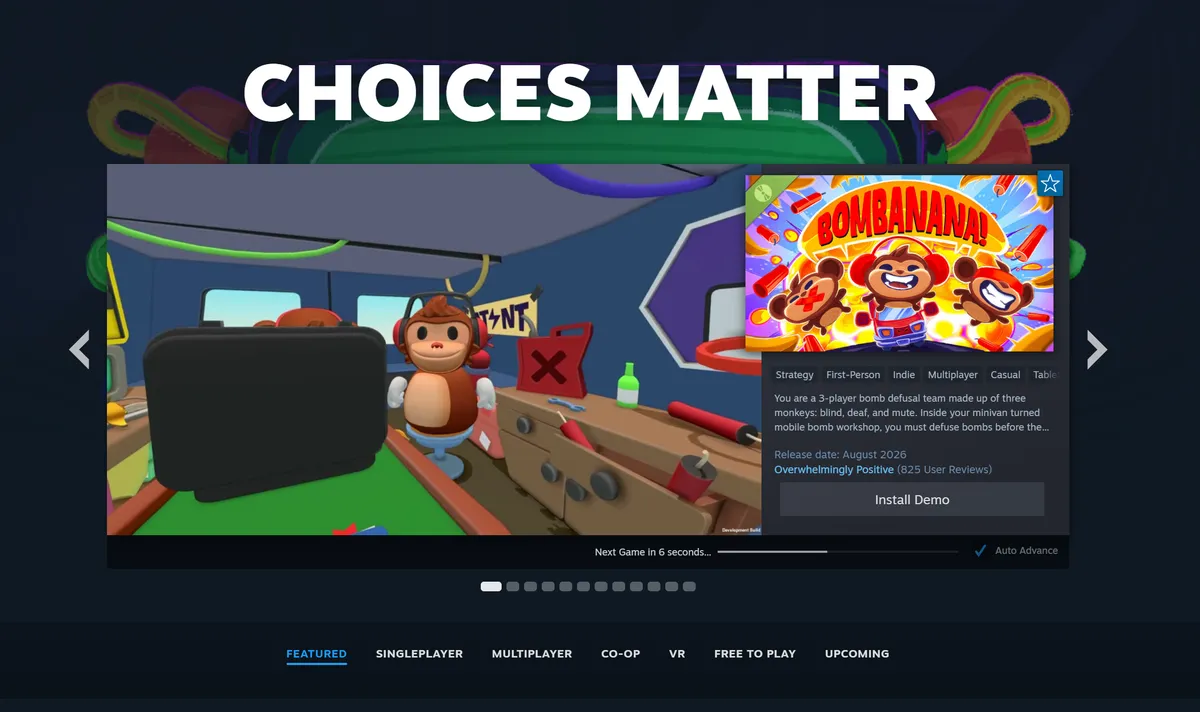
As narrative designers though, it behooves us to see through this fog. Ultimately the job is about maximizing the potential of the game and story we're actually making, not about trying to meet an arbitrary, external standard that was more or less invented by marketers to sell other people's games.
This is not, to be clear, an anti-anti argument; I don't think you have to abandon the idea of consequential or "meaningful" choice—but you don't have to let it rule you, either. It is one thing you can do. Some games have different experiential goals (while still having a lot of use for choice-based narrative). And even in games with big consequential choices, they often only want to use those as part of a palette of different techniques.
For narrative design to be a field, it can't have "a direction". We can't treat this process as trying to convince everyone to move with you. It has to have both well-trod territory—I wish we didn't forget the maps so much—and unexplored frontiers. And those, necessarily, splay out in all directions from wherever you might be standing.
In reality, all choices also serve a rhythmic function by acting as interruptions in the simple flow of narrative that prompt the player to interact. As a practical matter I tend to think of this as a third, distinct element from the structural and rhetorical systems that I'm talking about in this article, although you could also argue that rhythm and structure are just micro/macro-scale manifestations of the same phenomena.↩